Showing posts with label books. Show all posts

Tuesday, June 5, 2012

Nero Wolfe

Like any serious reader, when I find an author I really really like, I read everything that author has written. This is sort of like a love affair between author and reader. The author gives you as much as you want; the casual date takes a kiss and moves on, while the serious lover takes it all, sometimes even repeating a book when once isn't enough. This is not casually liking an author, or even loving a particular book. This is absorbing everything until there is nothing left. For most readers, this doesn't happen very often, just as with lovers in real life it doesn't happen very often. Who has the energy? But every now and then...

I've read a lot of mysteries, and enjoy a lot of mystery authors, and have even read the full works of some of them like Hammett or Chandler. But none have been such feverish affairs as the one I have had with Rex Stout and Nero Wolfe. I remember my first Wolfe novel, The Doorbell Rang. It comes in the middle somewhere of Stout's total output (48 Wolfe books altogether), but that doesn't really matter, because the first thing you notice about the series is that you can pretty much start anywhere. Most mystery authors nowadays, if you don't read their books in the order in which they were written, you're lost: they're one giant epic in serial parts, rather than stand-alone installments. This may be fine for committed fans, but it's murder on newbies who may pick up the latest and be immediately lost. You're never lost with Nero Wolfe, though. Still, there are occasional plot developments from novel to novel, and it doesn't hurt when you get serious to read them in order. But to start, pick any one at random. Then go back and do the rest. In other words, a real easy buy-in.

The novels are narrated by Wolfe's amanuensis, Archie Goodwin, and as Annabelle Mortensen points out in The Genius of West 35th Street, he is the perfect foil to his boss. Archie is hardboiled, while Wolfe is drawing room. They are from completely different traditions in mystery writing, yet they blend perfectly, and as some would have it, uniquely. No one else ever pulled off this mix like Stout. What you learn early on in any of the stories is that Wolfe has very specific rules about how he spends his time and where. One of the real joys of the series is seeing if those rules will broken. They often are, but they still remain as rules. Stout pulls this off beautifully.

If you don't know the Nero Wolfe books, I would recommend that, first, you read one. As I said, any one. Then take a look at Mortensen's fine article, to give yourself a sense of where these books fit in the genre. Then read the rest of them. Just to keep in with the spirit of things, I'm immediately going to put Fer-de-Lance on my Kindle. I need to read this book again real soon. It's been a couple of years since my last Wolfe. I need to rejoin the pack.
.

Hello. My name is John. I'll be your hitchhiker this evening.

The idea that you would be driving along and would see John Waters with his thumb out on the highway was, shall we say, a little bizarre, except with John Waters, calling something bizarre requires a lot of thought beforehand. But there he was, hitching away, and one of the cars that picked him up was carrying a bunch of indy rock musicians, and the rest is history. And also fodder, apparently, for an upcoming book.

That's the thing. Waters is a writer, and a good one. His Role Models is undownputtable, and rather undescribable aside from saying that it is, indeed, about some of his role models. It was the first book I bought for my iPad: a baptism of trash, you might say, provided that you are the sort of person who values trash.

Waters is also a talker, and in addition to recommending his book, I recommend his film John Waters: This Filthy World. It's just Waters talking, and he's a great raconteur as he talks about his filmmaking roots. And of course, he is a filmmaker, with varying results. You've probably seen Hairspray (not the musical); if not, do so now. Or Cry-Baby, with Johnny Depp. Neither is for adults only, if that's a concern. They're certainly his most accessible works.

You're on your own after that.

BigThink.com has a bunch of Waters videos (and a lot of other people as well). I picked the two below as representative. Watch them, and then ask yourself, if you saw Waters hitchhiking, would you pick him up? I would, in an instant.


.


Tuesday, May 29, 2012

How to write a book that will last forever

One thing that readers can't ignore is the bestseller list, even if they patently avoid reading anything on it. After all, it seems to take up about half the New York Times Book Review these days. How can you miss it?

The first thing we learn about popularity is that it is no particular indicator of quality. (Anyone who doubts this can learn a quick lesson by consulting the Billboard 100 and trying to find the good music.) Nevertheless, the bestseller list looms as a weekly reminder that new books are always being written, mostly by the same people over and over again, and that someone is buying them in prodigious numbers, and, probably, we are not among them.

Then again, there is a game to be played by those in a Grinwoutian position of working in the publishing trade. Since we are in charge of a series of popular novels, often drawn from the bestseller lists, and because we read an inordinate amount of popular fiction, there is always the challenge of tallying how many bestseller notches one can actually carve into the one's Kindle. There are times when I've read virtually all of the books on the list, and as often, times when I've read virtually none. Usually this is a factor of series-dom, where all the books on the list are the 27th in some series of aliens versus Jane Austen or some such that wouldn't normally fall into my purview. Still, when I see I've read a whole bunch, if not the whole bunch, I find myself gloating a bit. I feel like I have my finger on the proverbial pulse. (I also feel like my brain is melting into nothingness, but we're not here to talk about the negative side effects of keeping up.)

Another game to play, in addition to "How Many Have I Read?" is "Where are They Now?" You do this by going back to a bestseller list some many years ago, and looking at the books and their authors, and asking yourself not if you've read any of them, but if any of them are even around anymore. How many bestsellers of the past have been tossed on the dustheaps of momentary popularity? Two million people read it the day it came out, and another ten million were champing at the bit waiting for the paperback, and today you can't even find it at Amazon.

Fame is fleeting.

But not all the books on the bestseller list are mere potboilers, that you'd expect to fade away with the passing of time. Some of them, in their day, were touted as literary art. Some were by people who won the Nobel prize. Some of them were even by (shudder) Ayn Rand. So the question arises, why do some books last and others not? Assuming an inherent quality—so much for Ayn Rand—what is it about that quality that lasts, or doesn't? Why is literary fame so unpredictable is a good essay on the subject from the New Yorker Page-Turner blog. If you're interested in this subject, check it out.
.

Monday, May 21, 2012

A pair of Bonds

I've been reading the James Bond novels lately, having been curious after seeing Casino Royale, which the critics claimed was much like the book. It was, but at that point Fleming's writing was sort of clunky. He got better though, and soon enough the Bond stories became what they should be, the perfect thing to pass the time on an airplane or equivalent. Considering what the movies became, by comparison they're not particularly complicated; you get the feeling that if someone had mentioned the idea of subplots to the author, he would have passed out from exhaustion just thinking about it. For instance, in From Russia With Love, half the book is the Russians talking about setting up a trap for Bond, then Bond sort of stumbles into the trap because the Brits are curious what kind of trap it is, and then an assassin almost kills him and it's sheer luck that Bond gets away, and there you are (until he gets killed at the end, that is). A straight line, completely. Come to think of it though, the movie was roughly the same. It wasn't until Goldfinger that the stunts and effects started outweighing the plots. Not that I'm complaining, mind you. I wanted to see how they'd outdo themselves this time as much as the next fan. That's what the Bond movies were all about.

In the early films, the part of Bond fitted Sean Connery to perfection, or vice versa. But as would be expected, he got tired of the role and bowed out, to be replaced by the unfortunate George Lazenby. It's not easy replacing the perfect actor for the part, and, well, as time has demonstrated, George Lazenby was no Sean Connery. Still, there are Bond film fans who claim that On Her Majesty's Secret Service is one of the best of the lot, Lazenby or no Lazenby. This interview [via Dangerous Minds], overflowing with grainy black-and-white clips that make you think that the movie must be good to look this bad, is of great value for any Bond film fan, as a very hippy looking (and cleft-chinless) Lazenby explains what happened.


Flash forward. The next movie in the series, starring Daniel Craig, will be the Bondly titled Skyfall. This is just a teaser clip [via Esquire], unlike the extended take above, but you've got to admit, they put their money where the money ought to go. This will not be what you would call a catch-as-catch-can low-budgeter.


Over time some things change, some things remain the same. And if you don't like this particular Bond, just wait a while. A new one will be coming down the pike sooner or later. But I have to say, if that teaser is any indication, this one's got the stuff.
.

Tuesday, May 15, 2012

Oz

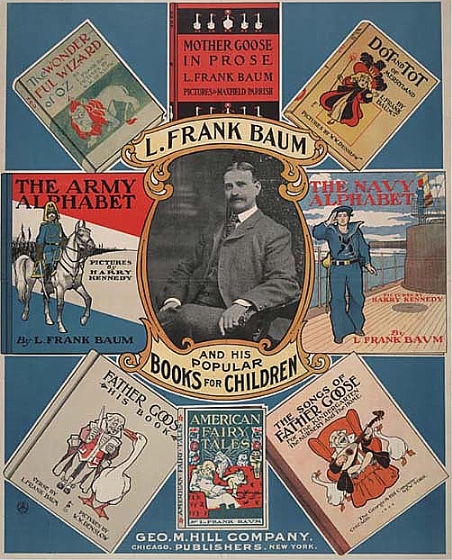
L. Frank Baum was born on this date in 1856. He attended the Peekskill Military Academy in Peekskill, NY, when he was 12. There is a small stretch of yellow brick down by the train station that those of use who live in the area like to believe was a particular inspiration to him, in that he was given directions to the school, on first getting off the train, to follow the yellow brick road. This story is, maybe, true. The idea that the word Oz comes from looking at a filing cabinet labeled O-Z may also be true. Maybe not.

What is true is that the book The Wonderful Wizard of Oz, published in 1900, was a big success. Baum followed it with 13 other Oz novels, as well as some Oz-like novels taking place in the surrounding territories, like Ev and Ix, and a warm-hearted biography The Life and Adventures of Santa Claus. But Oz was the big achievement.

You need to know a few things about Oz. It is not, as a certain movie would lead you to believe, an imaginary place, although it did cut itself off from communication with the rest of the world. In the original book, the Kansas part lasts about as long as it takes for the storm to brew, and then, whoosh, we’re not in Kansas anymore. For the first couple of stories, Baum has to transport Dorothy back and forth from Oz to Kansas, but eventually he moves her lock, stock and barrel to Oz permanently, along with her aunt and uncle. Much easier that way. And, of course, those shoes are silver, not ruby. And like the other animals in Oz, Toto can talk: he just usually chooses not to.

The Oz stories are wonderfully whimsical, with characters like the Woggle-Bug and the Patchwork Girl and Jack Pumpkinhead (who looks suspicially like Jack Skellington, if you ask me, but then again, any skinny guy with a round head is going to come out like that one way or the other). They are also filled with strong female characters who get things done, and don’t wait around to be rescued by princes of the charming persuasion. Baum himself had four sons; maybe he just longed for a daughter. Then again, he was a staunch feminist himself, and a strong supporter of women’s suffrage. It shows.

Oz survived Baum. The next set of novels were by Ruth Plumly Thompson, who stuck to the canon while adding some wonderful touches of her own. You can put her books beside Baum’s and give them to any kid just discovering chapter books, and you will have passed along a wonderful world of enchantment and fun (which, needless to say, had its share of librarians banning the books over the years, as they are wont to do, the reason being their lack of literary merit; so much for librarians). Other writers have taken a different tack from the canon, most notably Gregory Maguire’s recent series, begun with Wicked. He's not alone. Science fiction writers like Philip Jose Farmer and Robert A. Heinlein have also had a go at the place, and there are all sorts of television visits and comics and whatnot.

The best Oz remains the original, though. Even the Oz of MGM pales by comparison, even though it may be the most beloved movie ever. The thing about the real Oz is that it is almost endlessly rich, with all those Baum (and later Thompson) books. By the time you read them all, you can just go back and read them again. It’s a whole world, originally imagined by one man.

Baum died on May 6, 1919. Oz shows no sign of dying, ever.
.

Monday, May 7, 2012

Toni Morrison

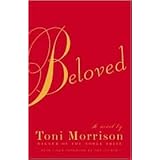
Chloe Wofford became Toni Morrison by chance: childhood nickname and ex-husband's surname. It was Toni Morrison who won the Nobel Prize, and whose Beloved has been ranked as the top novel of the last 25 years. But there is more than just the dichotomy of real and pen names. There is the dichotomy of polemic and literary writer.

Morrison writes—more and more consciously, it seems—for posterity. Having once spearheaded the elevation of black women in culture—Maya Angelou, Alice Walker, Oprah—she now finds herself struggling to cut them loose, to admit at long last what she’s always believed: that she’s not only the first, but the best. That she belongs as much with Faulkner and Joyce and Roth as she does with that illustrious sisterhood. That she will pass the test that begins only after Chloe Wofford is gone, and Toni Morrison is all that’s left.

Boris Kachka's profile of Morrison in New York—Who Is the Author of Toni Morrison?—will make you pull down a Morrison book or two from the shelf.
.

Friday, May 4, 2012

Must See TV

I can remember watching television in the 70s. There was one big block, Saturday nights on CBS. MASH, All in the Family, Mary Tyler Moore, Bob Newhart. If you were home on Saturday night, you watched these. You'd be crazy not to. And keep in mind, there were no VCRs then, much less DVRs and Netflix and Hulu. You watched what was on, and that was the end of it.

Those shows marked a golden age that wasn't repeated until NBC conquered Thursday night in the 90s. Cheers, Friends, Seinfeld, ER. Must see TV, they called it.

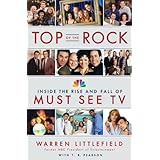
Warren Littlefield was the President of NBC Entertainment in the 90s, and he's out on the circuit pushing an oral history of the shows of Must See TV. You might have caught him on the radio or TV, talking about it. The Atlantic has a major interview by Kevin Fallon. Take the genesis of Will and Grace for instance, a show that might have a hard time getting on the air in 2012.

Management said, "What the hell are you doing? Why are you developing Will and Grace?" It's network television, and we have advertisers to answer to. Advertisers are not ready to embrace, at the core of a show, a relationship between a gay man and straight woman. What are you doing? To make matter worse, we're in business with these writers. We own them. They're under a deal to our company. So it's not like you're wasting somebody else's time and money. You're wasting ours.

Very inside baseball, but worth a read. The Death of Must See TV: A Former Executive on NBC's Rise and Fall.
.

Thursday, May 3, 2012

Neil Gaiman interviews Stephen King

What? I know. You don't need to hear anything more for us, and want to go read this sucker. But we can't resist a teaser:

I was down here in the supermarket, and this old woman comes around the corner this old woman – obviously one of the kind of women who says whatever is on her brain. She said, 'I know who you are, you are the horror writer. I don’t read anything that you do, but I respect your right to do it. I just like things more genuine, like that Shawshank Redemption.'

“And I said, 'I wrote that'. And she said, 'No you didn’t'. And she walked off and went on her way.”


A Stephen King Interview.

[Via The Browser.]
.

Monday, April 30, 2012

Neal Stephenson

If you like really, really long books, then look into Neal Stephenson. Our first exposure was Cyrptonomicon (1168 pages). Loved it. Then there was the Baroque Cycle (2256 pp), and Anathem (981 pp), both of them enormous fan favorites. We haven't read Reamde yet, and can't decide whether to read the physical book that we have on our shelf (1056 pp) or listen to the audiobook, which we have on our iPhone (38 hours and 34 minutes). We can recommend Snow Crash with only two reservations: it's got a lot of Sumerians in it, and it's only 440 pages long, a veritable short story by Stephenson standards. They have the original of one of his manuscripts at the Science Fiction Museum in Seattle. It's about as tall as an eighth-grader.

Stephenson has a new project with some fellow writers...


Yeah, book trailers are dumb. The ones that are good to watch seem totally removed from the act of reading. Oh, well. We'd read NS no matter what he does, or who he does it with. We just have to remember to set aside a few weeks in advance.

[Video via Geek Dad.]
.

Friday, April 20, 2012

Charlotte's Web

"Some pig..."

Of all the books I have read that were written for children, either as an adult or a child myself, many were very good. But only a few were, and are, special. Shockingly, to anyone who looks up at the logo for this site, the Alice books were among those special ones. I first read them as a teenager; I haven't stopped reading them yet. I don't think they're particularly satisfying when read aloud to younger children; it's hard to follow the logic and language unless you're reading them yourself. Maybe Victorian children were smarter than kids in my day. In any case, the impression the Alice books have had on innumerable writers and artists is undeniable. And they are, ostensibly, children's books.

Special in a different way is Charlotte's Web. I read this for the first time when I was reading it aloud to my daughter when she was quite young. I had read White material before that was intended for adults, but never his works for kids. I expected it to be good. I didn't expect it to be so affecting that I could barely speak the last words of the book because I was reacting so emotionally to them. It might have something to do with being something of a writer myself, on top of everything else. In any case, those last words have never left me.

Amazon's Omnivoracious, celebrating the 60th anniversary of the book, has brought forth the original catalog copy from 1952. If you're a Charlotte fan, it will give you a nice warm glow to read it. If you're not a Charlotte fan, you obviously have never read the book, and you need to drop everything and do so now.

David Sedaris

Most of us probably come to Sedaris first as an audio experience, maybe hearing him on This American Life, as likely as not with the Santaland Diaries. You immediately know that you want to hear more, so you seek out the audio versions of his books, and discover that the one or two stories you've heard before were not flukes. He is an expert performer of his own work, either cold in a studio or hot in front of an audience. He doesn't have the vocal chops of, say, James Earl Jones, but if Jones were reading Sedaris, it just wouldn't work right. Then again, Sedaris would have been a lousy voice actor for Darth Vader. But he's perfect for David Sedaris, and that's more than you can say for a lot of writers and their own work. His writing just happens to translate perfectly to his voice.

This wouldn't be terribly notable if it wasn't for the fact that Sedaris as a writer, absent his reading aloud his material, is very strong. You can read his stories without listening to them, and without even trying to imagine his voice in your mind if you already know it, and the stuff is really good. He's a good writer and a good (albeit limited) performer both. Pick whichever pleases you, but you won't go wrong either way.

If you're unfamiliar with Sedaris (how could that be?), you might want to start with a By the Book interview with him in the NY Times:

Boy, did I have a hard time with “Moby-Dick.” I read it for an assignment 10 years ago and realized after the first few pages that without some sort of a reward system I was never going to make any progress. I told myself that I couldn’t bathe, shave, brush my teeth or change my clothes until I had finished it. In the end, I stunk much more than the book did.

More Bond. James Bond.

James Bond goes on long after the passing of creator Ian Fleming (right) in 1964 (the year the film Goldfinger was released). Bond was iconic to begin with, or at least once Fleming got the hang of the character. In the first couple of novels the author seems to be finding his way, but by the time he got to Moonraker, he knew what he was doing. There is a combination of plot and explanatory detail that normally readers would find annoying, but with Bond, the explanatory detail is the liquor he consumes or the cities he visits or the cigarettes that he smokes, all of it relayed in a professorial matter-of-fact style that ultimately set the character as not real to anyone, but at the same time, more real than real. Hyper-real, in other words. There was never a spy anything remotely like the fictional James Bond, who became the quintessential version of what what we think of as a spy. How many other characters can you think of that have both outlasted their author and outlasted their fictional portrayers? In the movies Sean Connery was the quintessential Bond just as Bond was the quintessential spy, but that didn't stop Lazenby, Moore, Dalton, Brosnan or Craig. Nor will it probably stop the next fellow.

The novels too went on after the novelist died. Kingsley Amis, John Gardner and others have taken on the task of writing Bond novels, most recent among them being Jeffery Deaver with Carte Blanche, a reboot of sorts. Carte Blanche can be recommended to the most die-hard Flemingian Bond fan as a very good Bond novel, but at the same time, it is also a very good Jeffery Deaver novel. The author was obviously allowed to write his own book, rather than trying to imitate the original.

Next up to take on Bond will be William Boyd, a rather marvelous author in his own right, known for An Ice-Cream War and A Good Man in Africa, both Grinwout's recommendations. He comments himself on his license to write a William Boyd book, plus some other extremely interesting things, in a Telegraph interview: William Boyd on challenges of writing the latest James Bond novel. It's definitely a must for Bond fans.

Of course, the one character that does come to mind as comparable—actually, the one who probably sets the standard for outlasting creator and portrayers—is Sherlock Holmes, the quintessential detective to Bond's quintessential spy. There are some fun takes on the twists of the Holmes legacy at Sherlock Holmes’ Odder Fodder: Curious Books Featuring the Great Detective. Looking for the Holmes guide to self defense, for instance? This article will lead you to it.

Wednesday, April 18, 2012

Robert Caro

The Power Broker is the best biography I have ever read. Let's get that out of the way first. And I've read, and loved, a lot of biographies. But never have I come away from a book with such a strong feeling of knowledge of its subject. Robert Moses was a most amazing figure, a strong-arm character, a conniver, a dreamer, very much the power broker as the title says. He built big, and often terribly wrong. I don't think I would have liked him as a human being. I've often wondered if author Robert Caro felt likewise.

After Robert Moses, Caro went on to Lyndon Baines Johnson, a similar figure in many ways, especially in the manipulation of power. I read the first volume, and I've been waiting for Caro to finish ever since, but every time a new volume comes out, it is not the last. I've given up. I'm going to get the ones that are out there on my Kindle and have done with it. By the time I'm finished with them, with any luck the final volume will be out. The (presumably) penultimate volume is coming out in a few weeks.

But, well, that Kindle... There's the rub. Publishing is changing these days, and the Grinwout is in the thick of it. Publishers don't really know where they're going with digital products, but they're going there a mile a minute. One fear is that we are creating a business of publishing—fast and electronic—that will no longer be able to support garganutan projects like Caro's LBJ biography. And the world will be a lesser place for it, if that is true.

[Knopf editor Sonny Mehta] pulls each of Caro's books off his shelf, The Power Broker and the first three Johnson volumes. He stacks them on his desk like blocks, resting his hand on top of the pile, saving a place for the next one. "I can't imagine this being done or even attempted by anyone else," Mehta says, almost to himself. "He's given over so much of his life to another guy." It's not just Caro's single-mindedness that makes repeating The Years of Lyndon Johnson a modern impossibility... Books like Caro's don't make corporate sense anymore, if they ever did. They require not just staggering investments of time but also of money, of jet fuel and paper and cloth. There will be five books now rather than four — and in the beginning, there were meant to be three — partly because they became victims of their own physical scale.

This is from a profile of Caro by Chris Jones in the May 2012 Esquire, The Big Book. It is required reading for anyone who cares about words, and how they are disseminated.

Keith meets Mick

Mick is the greatest R&B singer this side of the Atlantic and I don't mean maybe. I play guitar (electric) Chuck style we got us a bass player and drummer and rhythm-guitar and we practice 2 or 3 nights a week. SWINGIN'.

Letter of Note printed Richards's letter to his aunt, He is called Mick Jagger, and as we ease into the 50th anniversary of the Rolling Stones, and various reports come and go about their touring again, or not, and recording again, and not, and for that matter, talking to one another civilly again, or not, it's fun to recollect that at some point in rock and roll there were no Rolling Stones. At one point in classical music there was no Bach or Beethoven either, so everything has to come from somewhere.

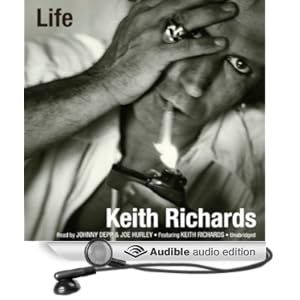
As Richards describes in Life, the group came together over classic R&B and some serious record collecting. In the early 60s, if you wanted music, you didn't bit torrent it when the spirit moved you. You had to haunt the record shops, and for the Brits, that meant scouring through not just records but imports to boot, and, for that matter, 45s, the one-song singles. Albums weren't the thing yet, although they did exist. Being a music fan was work, but it was worth it because it got you past the mainstream into where the action was. And, if you were lucky, it helped you create the Rolling Stones.

Richards's autobiography is highly recommended, but I would suggest you forego the paper version and acquire the audiobook, which he reads some of, along with Johnny Depp (and another narrator of less fame, but much ability). It's a worthwhile combination of performance and content, which as has been noted on earlier posts, is what audiobooks are all about.

The book tour

If you're going to write a novel, which is an endeavor of great discipline, you're going to imagine a number of things. First of all, you're going to imagine that your book will be a bestseller, and you'll make enough money to give up your day job at the widget factory to spend the rest of your free time playing golf with Jame Patterson down in Palm Beach. Then you're going to have to believe that your great success means that your hungry fans want to meet you in the flesh and listen to you read from your future classic.

It is nice to dream.

A number of writers have finished their books, and with varying degrees of success (and I'm not sure how many rounds on the links with Mr. Patterson) gone on tour to promote their work. The results, as repaired in The Awl, have been mixed:

No one has heckled me yet, although I did have one guy at a reading come up to me and start asking me questions about the technology of the TM-31 and how it works and it took about five minutes for me to realize what was happening—it was about the time that I noticed how glassy his eyes were—and then he finally just came out and said it: he was a time traveler, too, and he wanted to know if I could do it anytime I wanted or had to use the machine the way I described in the book.

The title of the piece is self-explanatory. It's fun even if you don't have a bestseller in your personal oven: Nine Writers And Publicists Tell All About Readings And Book Tours.

Tuesday, April 17, 2012

Haruki Murakami

1Q84 was Grinwout's first exposure to Murakami. It's a multi-narrative novel in which time shifts from the contemporary year 1984 to the year 1Q84, and unusual things ensue, including the sudden appearance of a second moon. It's a book unlike any in our previous experience; we followed up with Hard-Boiled Wonderland and the End of the World. It's a dual narrative this time out, from the same narrator in different, inner realities.

Intriguing stuff.

If you start to dabble in Murakami, you can't help but want to know more. This BBC program is intriguing on its own, and quite representative. (Via)

Writing about love

That's an interesting problem. If we write about love, we have to navigate all sorts of shoals, including the insipid. It is hard to put emotions into words. I can write something that might scare you, that is, I might be able to arouse an emotion within the reader, but I would be much harder pressed to create a scene where a character is scared. The former is a matter of elementary narrative mechanics, the latter is a matter of artistic writing skills, which are much harder to master. A film analogy might be when we see the menace over the unexacting victim's shoulder or the lights go out or a door slams. Basic stuff.

Love scenes are similar. We could probably come up with the mechanics of characters falling in love without necessarily stooping to the pornographic, but how do we express the emotions? For that matter, if we want to discuss the art of love-making, can it be done without it being mechanical and predictable and pornographic? On the other hand, how do we separate the ephemeral—the beauty of being in love—from the mundane—trite expressions that simply relate that being in love must be beautiful?

Kurt Cornutt addresses some of this on the Oxford University Press blog in an article called The Love Songs of F. Scott Fitzgerald. Fitzgerald aspired to greatness in his novels, but meanwhile he pumped out a lot of short stories, simply for the money:

For Fitzgerald, the short story was a means to an end: it allowed him to finance his novel writing, which he considered the preeminent art form... He also resented the story market for enticing him to prostitute his talent. To command courtesan prices, he had to know how to his please his audience – and that meant recycling familiar themes, employing stock characters and scenarios, and tugging the heartstrings. What more artistically he might have accomplished, commentators lament, had he not been so dependent on this dirty money.

Cornutt examines some of Fitzgerald's love-story writing, and even compares it to Brian Wilson's love-song writing. I'm taken by the underlying question of portrayals of emotion, but I also have to admit, I liked learning about this side of Fitzgerald's career.

Monday, April 16, 2012

The Secret Garden

How often do writers really understand their own work? It's one thing if a writer puts out, say, three or four books in a lifetime. James Joyce wrote three novels and a bunch of short stories, and no doubt was fairly aware of the differences among them. They happen to progress in a straight line of modernism: you can read Portrait, you can struggle through Ulysses, and you can spend a week or two parsing the first page of Finnegan. Joyce had to realize that there weren't a lot of people who were going to think of Finnegans Wake as a good airplane read (or whatever constituted such in his day). So I would suggest that Joyce understood his own work.

What about Stephen King? He's written more books that he can probably remember. With that large an oeuvre, how can he possibly imagine which books will truly be his legacy? No matter what he happens to think, I'll bet he's wrong, simply because the odds are against him.

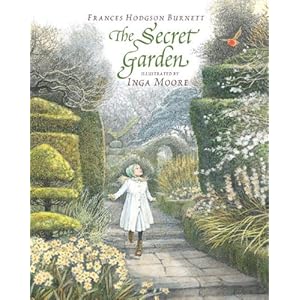
Look at Frances Hodgson Burnett. She wrote 52 novels and 13 plays. As primarily a writer for adults, no doubt she would be surprised to learn that she is now known for exactly one book, The Secret Garden. A Little Princess and Little Lord Fauntleroy may ring some bells among readers who like to go exceptionally deep, but that's about it. At the height of her quite extensive fame, Burnett moved into an estate in Kent:

Like her adolescent heroine, Burnett was led by a robin to the door hidden in the crumbling, ivy-covered garden wall; she executed a massive restoration project with the head gardener, expanding the view of the lawns, planting hundreds of flowers, and constructing a rose walkway. She settled into writing under a gazebo with her tame robin fluttering nearby. The book she worked on that first summer was not The Secret Garden, however, but one she had long labored over and was convinced would be her literary masterpiece, In Connection with the DeWilloughby Claim.

In Connection with the DeWilloughby Claim? Never heard of it. Burnett's story is an interesting one, especially if you're a fan of her work: Secret Gardens by Vanessa Blakeslee for the Paris Review.

Audiobooks vs bookbooks

I've written on this subject in the past. Having a long commute by car, I've become an enormous fan of audiobooks, but that's not as simple as it sounds. The first question is, what books make sense as audiobooks, and which would you prefer to read as books? One touchpoint is when a book is read by someone who is really good at it. Audiobooks are a matter of performance as well as content, and a good performer adds a whole dimension to the book experience that is not there in one's own reading the page. Recently I acquired an old reading of The Wonderful Wizard of Oz. I wanted to throw it, and the reader, out the window. The performance gave new meaning to the words saccharine and ponderous, simultaneously. Meanwhile, Audible has just put out a performance of the book by Anne Hathaway. That one I'll try. If she can't do it, no one can.

Jenni Landman talks about the whole business of book in the Chicago Tribune, reading versus listening, in a reasoned fashion. And she interviews Audible founder/CEO Don Katz, who has his own worthy two cents to throw in. One problem with audiobooks that is acknowledged is that, presently, when you listen to an audiobook, you're sort of stuck on a conveyor belt. You keep going forward. And sometimes that's now exactly what you want:

If I read a book after listening to it, it's because I haven't gotten my fill of the language. I want to spend more time running the prose across my tongue, reveling in the writer's grace notes. This ability to savor is missing from the recorded books experience. Mp3 players don't accommodate thoughtful pauses. Scroll back to a review a passage, and you are suddenly three chapters off and now unable to find your place.

I hate losing my place, because it can drive you crazy trying to find it again. I hate being driven crazy while I'm driving!

If you like audiobooks, or wonder about them, read Audiobooks: Are they really the same as reading?

Friday, April 13, 2012

What to read

"Read books. As often as you can. Mostly classics."

We posted Maura Kelly's slow books manifesto not long ago. She promoted the idea of reading the good stuff, and it makes sense. There is a lot of great literature out there, and an awful lot of it is simply wonderful to read. So, why not read it?

There's another side to this coin, however. Sure, I love Moby-Dick, but I have to admit, I also like James Bond novels. I have Melville and Fleming both on my Kindle. As a proselytizer for books and reading, I have to believe that any reading is a good thing, and that reading for pure entertainment is a perfectly acceptable activity. When I recommend books to teenagers, I always suggest books that I think they will enjoy, not books that I think will be good for them. James W. Hall, author of Hit Lit, makes this point at Speakeasy:

How can anyone who loves books not take heart in seeing so many new readers huddled up with a novel? Whether it’s “Harry Potter,” “The Hunger Games” or “Infinite Jest”—does it really matter? These days, when reading fiction seems like an endangered activity, why should we begrudge the success of any book, especially one that stirs such passion with younger readers?

We can't let an artificial line between so-called good books and books that will capture kids' imagination keep them away from reading in general. And, perhaps, the reading of what they want to read today make them eventual readers of those so-called good books tomorrow.

The weekend is here. Take a gander at Beware Literary Snobbery: Why We Should Read Bestsellers. And then go off and read a good book, however you define it.